
Institutional design and reform
Companies redraw the organization when growth, a purchase, or a second state makes the old path ridiculous.

The practice has four lines of work. A board that can no longer explain its own rules. A growth decision that has to survive a lender. A plant or a network whose week no longer matches the chart. A system that has to change without opening a new gap in compliance.
They are listed separately because a client usually arrives with one of them in front. In the room, they tend to meet.
This is the same work we do with organizations in Michigan, Illinois, and Ohio.

Governance work starts when the organization has outgrown the way it makes decisions.
Companies redraw the organization when growth, a purchase, or a second state makes the old path ridiculous.

A framework that lives in a binder is a record of an intention.

Strategies fail in the gap between people who agreed in a meeting and people who have to change their week.

Some institutions need a wider set of voices than a management meeting provides: members, staff, a community the organization claims to serve.

Policies accumulate, and few of them are checked against the result they were written for.

A strategy that every department can interpret differently is not a strategy.

Growth is a choice of where not to go, as much as where to go.

A project paper that cannot be stressed is a request for faith.

Positioning is the sentence a customer would use, not the sentence in the brand book.

Planning season produces documents that quote the same ambition as last year.

A rule changes the cost, the timing, or the permission a strategy assumes.
From the funding decision to an energy project that is operating.

Operations problems rarely announce themselves as strategy.

Restructuring that starts with a new chart usually protects the titles and moves the confusion.
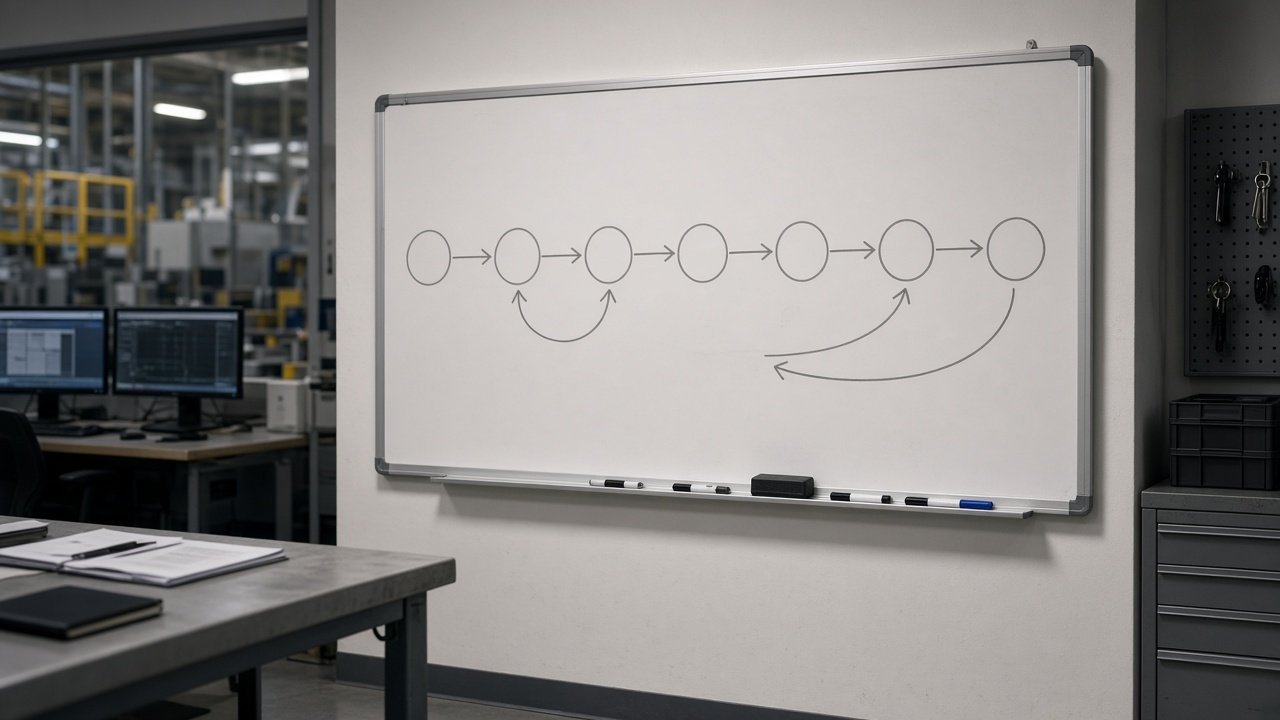
Process work has a bad reputation because it produces maps nobody follows.
The manual steps worth automating first, and who handles the exception.

A second source and a continuity plan for the vendors that can stop an order.

Where time and cost go, and what to reduce first without stopping delivery.

Most performance packs prove that last month happened. They do not help a manager act on Tuesday.

Training that is detached from the job is a day out of the schedule.

A new system can make an institution faster and harder to explain at the same time.

Migrations fail in the gap between the old record people trust and the new record the project team prefers.

A website, a store, and the database under them are one system to the customer and three projects to the company.

The numbers a company can use for a decision this week.
Where an automated step may act, what stays with a person, and how the result is measured.

Physical security is still how a person, a vendor, or a piece of equipment gets into the place where the work happens.

A risk register that is only a list does not tell a manager which risk is moving this week.